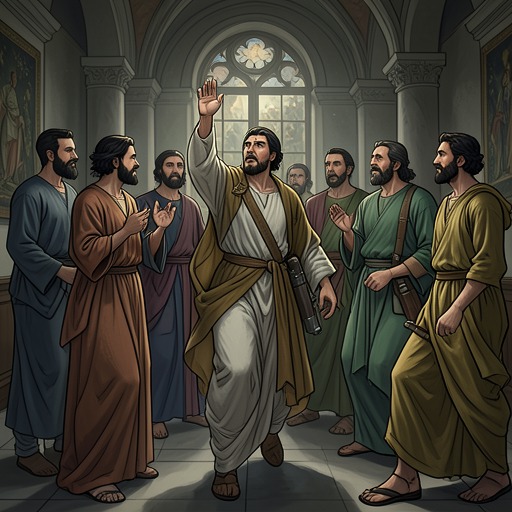
Jesus calms the storm
Don't Leave God Alone: How to Get God's Attention, Remain in His Presence, and Even Change His Mind to Make a Difference in Your WorldJesus calms the storm is the book’s clearest biblical model for responding to crisis without fear. In the account cited from Mark 4:35-39, Jesus is asleep during the storm, and when the disciples awaken Him, His first recorded words are "Peace, be still." The event becomes more than a rescue at sea: it establishes calm, authoritative speech as the proper response to threatening circumstances and supplies the pattern by which the book interprets later storms, dangers, and prayers.
Crisis and the Disciples’ Fear
The storm exposes a contrast between Jesus and the disciples. While the wind is raging, Jesus sleeps; the disciples, by contrast, react in alarm and wake Him. The book emphasizes that Jesus does not respond to bad news with panic or instruct the disciples to surrender to the danger. His immediate response is a direct command to the storm, making the scene a movement from apparent helplessness to active authority.
The same contrast reappears when Jesus later sends the disciples across the water and they are caught in another violent wind. They panic even though they had already witnessed His handling of a storm in Matthew 8:23-27. The book treats their fear as evidence that they had failed to draw on what they had learned: they could have trusted Jesus’s command to reach the other side, and they should have understood that the storm could be addressed rather than merely endured.
The Command That Changes the Scene
The decisive action is verbal. Jesus speaks "Peace, be still," and the command is presented as the first response that matters. The book connects this scene with Proverbs 18:21, which says that death and life are in the power of the tongue, and with its wider claim that words spoken from faith can confront mountains and alter circumstances. Jesus’s speech therefore functions as an act of authority, not merely as an expression of confidence.
The event is also linked with Jesus’s later teaching that a person who believes can speak to a mountain and expect it to move. In this framework, the storm becomes a visible image of every obstructing force: fear, delay, sickness, danger, or an apparently immovable situation. The required posture is not passive acceptance but a faith-filled command grounded in confidence rather than terror.
Repeated Storms and Progressive Faith
The disciples’ second encounter with a storm gives the event a recurring function in the book. Jesus’s earlier example should have become practical knowledge, yet the disciples still panic when the danger returns. Their failure shows that witnessing a deliverance is not the same as learning to act from the authority it reveals. The book consequently describes spiritual growth as progressive, moving from revelation to revelation and from faith to faith.
Moses’s crossing with his rod of authority is placed beside Jesus’s mastery over the storm. Both examples support the book’s claim that God’s servants must use what has been given to them rather than wait helplessly for circumstances to change. The disciples are expected not simply to admire Jesus’s power but to learn how to cross over, even when the passage initially appears doomed.
Later Testimonies of Storm Authority
The author applies the biblical scene to personal experience. During one tornado warning, the author and his wife stood at a window and commanded the tornado to go back into the sky. A large branch then struck the house, sending them to the basement in fear, although the tornado eventually passed by. The story is retained not as an uncomplicated triumph but as an admission that one apparent failure exposed their need to grow in dealing with storms.
On another occasion, a tornado formed beside a small medical office building near their home. The author and his wife told nearby doctors that Jesus would calm the storm and that they would speak to it. The doctors laughed and went inside for shelter, while the couple also moved indoors after addressing the storm. This time the tornado rose back into the sky and the storm dissipated. The differing outcomes did not persuade them to abandon the practice; the book presents persistence despite inconsistency as part of learning to exercise authority.
The public testimonies in the book broaden the event’s meaning. After 9/11, churches and prayer meetings filled as people sought God amid uncertainty, but the renewed dependence lasted only briefly. During the war, American troops seized Baghdad after twenty-one days, while later developments brought soldiers’ deaths and widespread violence. The author interprets the contrast through the idea of prayer coverage: when people stopped praying for military personnel, they had effectively left God alone regarding the matter.
The same pattern is applied to storms in Florida. In 2004, the author prophesied that Florida would face two back-to-back hurricanes and that prayer could keep them away, although people who prayed during the first occurrence still saw hurricanes arrive. The following year, hundreds prayed fervently after the author named a storm and a particular month, and that storm failed to hit them. In 2006, after collective and individual prayers following record hurricane seasons, no major hurricane struck the United States. These accounts show how the book extends Jesus’s command over one storm into a doctrine of persistent, communal prayer over public danger.
Personal Crisis and Theological Significance
The book also uses the storm as a template for responding to medical crisis. When a child from the author’s church was brought to an emergency room after an accident, the boy’s mother immediately declared that God would perform a miracle. Tests found no broken bones or internal injuries, only a slight concussion. The family’s first words, continued prayer, and spoken Scripture are presented as important elements in the account of protection.
A more severe family crisis involved the author’s wife’s father. After a mysterious fever returned, exploratory surgery revealed diverticulitis and a ruptured bowel. The infection led to septic shock, a medical coma, a temperature of 105 degrees, swelling to three times his normal size, multiple organ failure, dialysis, and a ventilator. The family prayed around the clock after doctors gave him less than a 50 percent chance of survival. Like the disciples in the boat, they faced circumstances that appeared to be moving toward death; like Jesus’s command over the storm, their response was framed as persistent faith rather than surrender.
The event’s lasting significance lies in its reversal of expected behavior. Bad news normally produces fear, and fear pushes people toward negative speech or away from prayer. Jesus’s conduct in the storm supplies the opposite pattern: He remains composed, speaks directly to the threat, and turns danger into a setting where authority becomes visible. In the book’s theology, the storm is not only something Jesus calms; it is a lesson that those who follow Him must continue to learn, repeat, and apply until they can cross to the other side without abandoning faith.